Showing posts with label what is sl?. Show all posts

Monday, 13 January 2014

The Red Pill

Let's see how deep the rabbit hole goes
Because I'm as mad as a hatter, I logged onto Facebook, and then Tumblr, this morning and invited questions from non-SL users about Second Life. I thought I might get a little variety in the questions, maybe get asked how something worked, or if such-and-such was true, but the four - I know, I know, I need to sit down, it's so many - responses I received were all to the tune of one question: What is Second Life, and why would you ever 'go' there?

Deep breath. 'What is Second Life' has got to be up there with the great unexplainable mysteries of life. God, the Big Bang, dark matters, why washing machines make widows of socks, why toast always lands butter-side down: we may never know the answer to these, nor may we ever come up with a completely satisfactory answer to What Second Life Is, but - take another deep breath - I am going to try and answer it nonetheless. I am going to bravely go where a thousand pink-haired rabbits have probably gone before me (we are talking about the Internet, after all). 

We're going to take the red pill. Fasten your seatbelt, Dorothy.

What is Second Life?
Second Life is a virtual world that exists somewhere within the Internet. When you download SL, what you are really doing is downloading what we call a 'viewer' - software with which to open a portal to allow you to see into, and create an avatar within, Second Life. The language of this suggests the opening of a window - literally - to view something which is already in existence just, usually, beyond your line of sight. When you log out and the window closes, the world carries on without you.

The easiest thing to do is to liken SL to a game - preferably, an MMO like World of Warcraft, except with more possibilities when it comes to character creation and customisation. Whilst this analogy works to explain how SL exists in the first place, it doesn't take into account that SL has no predefined objectives, no scoring system, no health or experience bars. In WoW, you can create characters that all exist in the same world, from the same lore, and all learn and level-up based on the same markers for advancement. In SL, not only do you not 'level-up', but the people you are meeting and interacting with may be pulling ideas and information from entirely different worlds and lores from you. The basis for the creation of their characters might be wildly different from yours, and you cannot even rely on the idea that the person before you comes from the same society as you in the real world, because that person could be from a country on the other side of the world from you. 

It's impossible not to draw similarities between SL and The Matrix. A whole virtual simulated world, a replica of the real world, which you reach by plugging yourself into a computer. If you die in the Matrix, you die in the real world - not the case with SL, but then that's because you cannot really die in SL. If someone upsets you in the virtual world, however, it's not so easy to let that emotion go when you go back to the real world. Whether you like it or not, just as your mind travels into the Matrix, so your mind travels with you into SL. And as Morpheus says and as I have repeated here ad nauseam, 'the mind makes it real'.

It's not all nearly as scary as I have made it sound there. Most of the characters I have come across have been 'normal' humans, so to speak, and because of time differences, and because of the social circles I have fallen in with, most of the people I meet are British or American. Those contexts are not, exactly, worlds apart. The only people I have come close to offending with my foreign-lore-ways were the Tolkien elves, and they turned out to be more laid back than I had been warned they would be. Usually, if you say please and thank you, and know how to take turns in a conversation, you'll be just fine.

In fact, SL seems to thrive on a kind of honesty not found, at least in my social circles, in real life. Anonymity can be a great bolster to confidence, but people in SL are often very forthright and open about things as personal as mental health, and sex. Sometimes, they can be a little too forthright, and as such, a lot of 'drama' takes place. Drama is a major issue for SL, and it's something that has been known to drive people away from engaging with the virtual world. 

Because of the drama, and because there is no specific law (that I am aware of) for SL, SL is populated with vigilantes. On forums, personal blogs, and social media networks such as Plurk, vigilantes launch attacks, rightly or wrongly, against those they deem to be wrongdoers, accusing them of everything from copyright infringement to child pornography. Charity fundraisers that didn't give the money they raised to charity, people that think it's O.K. to sell clothes featuring swastikas or dressed inspired by the Columbine school shooting, insensitive remarks about rape - it's all happened in SL, and it's all been pointed out and dealt with by vigilantes. In terms of social and individual empowerment, it's fantastic; but, with any good vigilante film, there's always the fear that people see and accuse first, and ask questions later. Butchering one person doesn't change a general attitude.  

In terms of physicality, SL looks like...well...a whole lot of different things. There is no one aesthetic, and no rhyme or reason to how the virtual world is arranged. If you owned the land and the building skills, you could place Australia beside, say, Sweden, and have one foot in each replica-country, except SL is usually more diverse than that. Instead of building two countries next to each other, more often than not I find I could have one foot in a boxing ring a la Fight Club, and the other in a meadow which is home to a race of fairies with mermaid fins. 

Because there are so many individual creators and designers, the lands (sims) you can walk through can change as often and as quickly as the English weather. Since there is no are-you-any-good-at-this test, the quality of the builds can vary dramatically, too, and they will only exist as long as you keep paying for the land you are renting from Linden Labs. If you stop paying, you lose your right to build there. If you choose to rent land through a middle man, and someone offers you a better deal, you can move your building to another virtually-physical location. In that way, you can never wholly be sure that the place you are trying to visit is still going to be there. I tried to teleport (main method of transportation, after walking) to the World's End Garden earlier (see what that looks like here - here!), and instead ended up on a sim full of everyday-looking houses and great big palm trees.

Why Second Life? What is the point?
Second Life means a lot of different things to a lot of different people, and what drives them to the virtual world in the first place is not necessarily what keeps them there. There's no way I can account for everyone's motives, but here are some thoughts.

SL is, potentially, a fantastic platform for design, creation, and money-making. Designing avatars and building houses in SL has the same appeal as designing avatars and building houses does on programmes such as the Sims. In SL, however, whilst you can get a limited about of clothes and items for free, things cost money, and land to build on costs money, and so many people turn to creating and selling their owns items or clothing in order to make SL pay for itself. For creatives, it's a great way to make a bit of pocket money, and also another forum for you to spread your artwork. I know of more than one real life artist who uses SL to sell artwork in various forms and to build up another fan-base. SL also offers access, thusly, to a wide range of other creatives with which you can bounce ideas and collaborate. That's exciting, no?

Some people with anxiety and/or depression also find solace in the virtual world. Being able to hide behind a different face can be a confidence booster, and it allows greater control over who you interact with, and when - especially since there are a thousand legitimate and familiar excuses you can employ to soften the I-don't-want-to-speak-to-you blow. There is one person I call friend who uses SL to get out and socialise because he is a full-time carer and cannot leave his house for personal time very often. 

It is also, alternatively, a place in which to hide - just as people hide from real life in books, games, and TV shows - , a place where the thing you are running from doesn't have to exist for a while. There's a danger there, in that a lot of expectation is made of what the virtual world is capable of, and sometimes it is all too easy to hide within its virtual boundaries and not to deal with the issues that originally drove us there. Alternatively, it offers a sanctuary in which to gather strength and support until you are ready to confront the real world. SL can't give you any answers that the real world can't, but perhaps the performance of life, the framing of it - and the performance and framing of yourself - can help lead you to the answers we can only get from ourselves.

Other people use SL as a place for self-experimentation, whether that be on a shall-I-dye-my-hair-purple level, or a am-I-into-BDSM-sex level. This ties (ha ha) into roleplay, but goes beyond just sexual roleplay - SL presents another medium in which to roleplay, listing itself beside the tabletop and forums. People in SL take RP very seriously, and the creation of collaborative stories like this is a wonderful thing in my opinion.

As I have written about here (- here!), there is no obligation to be the person you are in real life in your Second Life. If you want to log on and act like a chauvinist, off you go (it happens more than you might imagine). You can use your avatar to pretend to be confident, to pretend to be a rogue - to pretend to be whatever you like. As I've suggested, you don't even have to be human. You could be an animal, real or mythological, or a car, or an aeroplane, or a robot. The limits are the building skills of the virtual community.

The point, truly, is that Second Life has no point other than the point you give it, and many people stop engaging with Second Life when their original motive finds some real-life conclusion. If you get passed the difficult interface and utterly unintuitive avatar customisation, as well as the idiots that line up to flash their fake penises at newbies, there are some fantastic things to see in Second Life. Virtual coastlines, beautiful dream-worlds, spaceships, dragons, diners plucked straight out of the 1950s; if you can think of it, it probably exists, and if not, you can create it for yourself. 

Of course, there are an awful lot of fake penises kicking around, too.

Does that even begin to answer either question? There seems to be so much to say, but I think that is enough for now. I'm late for a very important date.

Sunday, 5 January 2014

Don't Nuke Our Cyberspace, Bro!

collective hallucination
I have begun reading a book, Technobiophilia, Nature and Cyberspace by Sue Thomas, and although I haven't read very much yet, it is really interesting. Interesting enough to send me scurrying back here to take screenshots of Kitti in space-soldier gear in the multi-coloured sensation that is the bar at Hangars Liquides.

Thomas cites John Perry Barlow's 2006 book, From Counterculture to Cyberculture, as discussing how 'the notion of the disembodiment of cyberspace got mixed up with mysticism and LSD for a while',  and goes on to say that the term 'cyberspace' itself has long been out of fashion, except with the military, 'where it represents a potential combat area'. In 2011, the US Department of Defense issued a document entitled a Strategy for Operating in Cyberspace, the purpose of which, as I understand it, was to encourage a full use of cyberspace for offensive and defensive purposes. In the foreword (these documents have forewords?!), Barack Obama wrote 'the digital world is no longer a lawless frontier' - but does not go on to say what the virtual world now is.

Thomas goes on to say that the internet, the World Wide Web, cyberspace, the whole lot, has deep roots in nature: 'the bramble of interwined ideas, links, documents, and images create an otherness as thick as a jungle'.

And that's it - that's what I'm getting at, getting into. In a few short pages of this book, a wonderfully terrible and frightening and empowering image of cyberspace, of the virtual world, as being something strange and dangerous and other has materialised. And it is complicated by Thomas' definition of cyberspace as being something that exists only in the mind - so this strange dangerous otherness becomes something we carry around in our heads.

Are you still with me? Maybe this is a bit self-indulgent, but hang in there.

There's a series of episodes of South Park in which the boys have to try to convince the military not to nuke the world's imagination after the imagination has been taken hostage by terrorists. The imagination becomes a battleground, and, in true South Park style the military do, of course, nuke it, and Santa has to save the day. I'm not sure that Santa is going to come and save us if our cyberspace gets nuked.

And doesn't it seem all-too-organic that cyberspace would be associated with LSD and hippydom, since it is a potential space of threat to the US Government? The opposition is almost funny.

What it seems to boil down to is vagueness. We don't yet know, truly, the limits of cyberspace. There are so many dark and shady places online, and in them lurk things most of us couldn't even dream up on an LSD trip. But the worst thing is that it, as a space, is organised. There are groups and hierarchies and networks along which pass all kinds of information in all kinds of formats. Very recently, people have met in cyberspace to organise, and then to conduct, riots and revolutions on grand scales. Is it any wonder that cyberspace and indeed the internet can be viewed as a threat?

Amongst the general public, understanding of how it all works can get mixed up and confused very easily, and misapprehension and not understanding something at all are wonderfully fertile grounds for fear.

Where do we, as inhabitants of the virtual world of Second Life - a 'collective hallucination' that has begun to have more tangible, more visible, roots, if anything in cyberspace does - fit into all of this? How much power do we have to shape cyberspace, considering that the space exists inside everyone who is aware of its existence to whatever degree and it is unlikely that we know nearly enough of these people to begin to make a dent? Whilst we might all be connected in cyberspace, we are most definitely not all listening to each other. Second Life is bigger than any one of us, and it is only a small part of cyberspace in the first place.

Already, it's starting to sound messy. I'm going to stop.

But isn't it interesting?

Friday, 20 December 2013

Turned

Vampires love knitted jumpers. Didn't you know?
sian pearl teleported to my skybox yesterday and found me on the roof, taking photos of Kitti posed with crystal tears and pointed white teeth. She said, 'Kitti has been a Creature of the Night a lot lately. Has she been Turned?' 'No,' I replied. 'Kitti is everything and nothing.' 

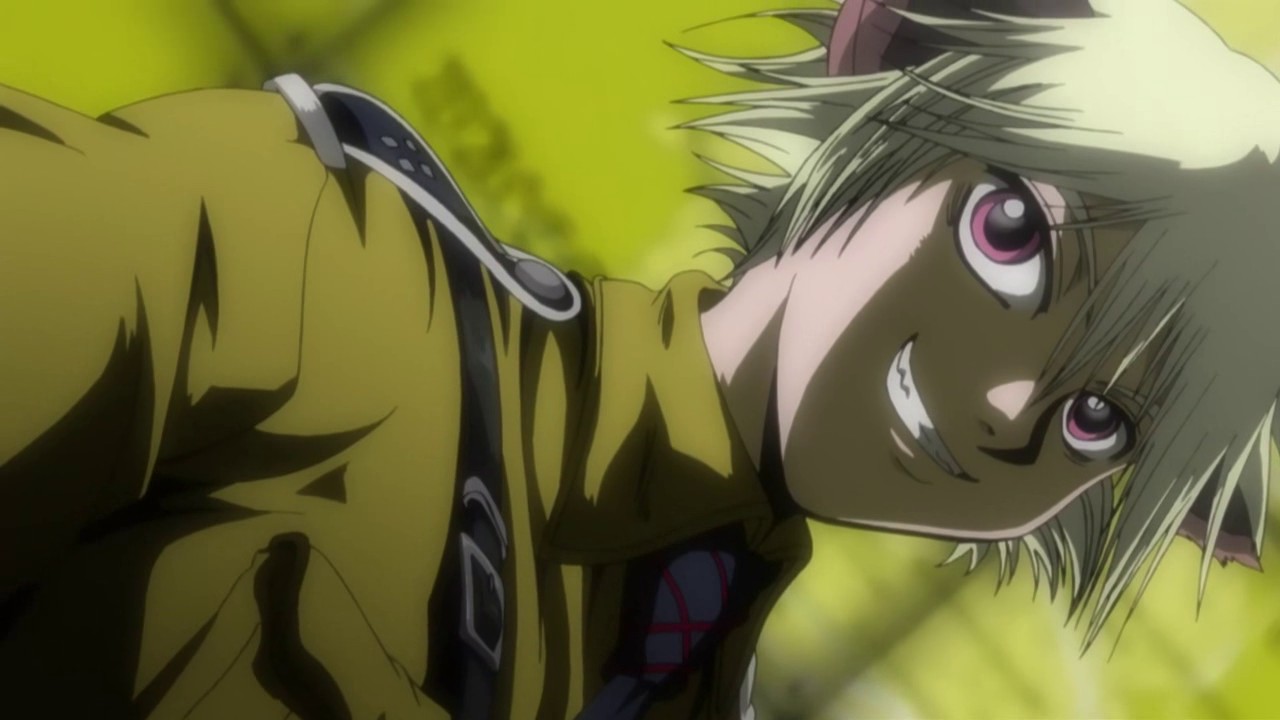
And then I giggled to myself (as I do) because I felt a little bit like Kohta Hirano's Warrant Officer Schroedinger, who likes to state often, courtesy of his maker's sense of humour, that he is 'everywhere and nowhere'.

I couldn't find any 'about' links that didn't lead to massive Hellsing spoilers, so I'm settling for this picture of him. Google his name at your own risk.
It's that line again, though, isn't it? - the making and breaking of Second Life, the reason to sign up and the reason never to sign in ever again. An avatar has the capacity to be everything and anything, but also to be absolutely nothing. Not everybody sees nothingness as a positive, nor as an opportunity. Freedom isn't necessarily the absence of all rules, regulations and obligations, but instead the ability to have decisions to make, and to make them for yourself. In nothingness, decisions have questionable use and importance, and if we cannot find a use or importance within ourselves, we flounder. I have said this a thousand times here, although I think that might be the most succinctly I have ever written it out.

It was kind of funny that sian made this observation, however, since all I think Kitti has consistently been lately is half-naked, and a little bit, well...of a fairy. This is new for me, as a lover of fantasy, because fairies have never been a creature I was especially interested in. And let's be fair here, Kitti doesn't look like the sort of fairy who is going to go around sprinkling magical dust or making flowers bloom, or collecting teeth - unless she'd knocked them out in the first place.

Mean Mischief
The naked-and-fey thing is courtesy of Monica Outlander and her BlackLabel collection. I haven't stopped wearing it for any real length of time since the Golden Thread show two weeks ago. It isn't that Kitti doesn't have other beautiful clothes - because she does - but I just keep switching back to the Miamai outfits. I'm addicted. And Monica Outlander is not a fan of t-shirts. We'll have the self-confidence conversation later.

I like the opportunity to play with Kitti's appearance, to dress her up sometimes as a vampire or a mean-looking fairy or anything else I can imagine. There are a few basic elements that I like to keep the same - her face and body shape, her hair colour (between two shades), her eye colour, etc - but everything else is up for grabs. And I enjoy that I can do it with such ease, and that the consequences of each change can be as significant or insignificant as I allow them to be. I am a whimsical shaper of nothingness. Let's go and play.

And on the subject of playing, I would like to wish you all a very Merry Christmas, and I hope that the new year brings you what you need to (or to continue to) be happy. I will see you on the other side of the sea of wrapping paper.

Friday, 13 December 2013

Stuck in Yesterday

Tiny irony: I took this screenshot last night...so technically, I took it yesterday. That is the level I'm at here.
Plurk has been buzzing lately with conversations about the changes Linden Labs have been trying to make to the Terms of Services and, freshly, news about the Australian annulment of same-sex marriage. I know very, very little about the former issue, but I saw the second on the BBC, and right in the middle of the television screen was a placard held by who-knows-who dismissing gay marriage because it isn't accepted in the Bible.

How are these two issues connected? They both represent our attempts to make new rules and regulations for today's people, and we aren't finding it very easy. If anything the media says is to be believed, there are many other ways in which our law system is becoming out of date. The very foundations of our societies are formed by treaties and agreements signed over fifty years ago by people who thought we'd all be flying around on jetpacks now if they could imagine this time at all. 


Those treaties and agreements are intensely important, and whilst they do the job generally, they don't take into account the way we have changed. They don't take into account the Internet, nor the collaborative way in which it allows people to work and to share ownership. In an age of CCTV and Obama reading our emails, we need to redefine 'privacy' and what we are entitled to. In an age of school shootings and children on Prozac, we need to have a conversation about mental health and gun ownership. I could go on.

That people think they are exempt from the law, even when that law has been revisited recently, is obvious: Mark Duggan, slavery in Bristol, even the crisis in Syria are examples of that. These issues should, technically, have been covered by the Geneva Convention, as well as anti-racism initiatives and on-going investigations into police brutality and what it does to your brain to hold a gun in your hand. It's a huge job but we have to keep going back, to look at these problems, to look at the laws and the attitudes that govern them. We need to make sure that they are applicable and relevant to the people they are governing, and we need initiatives in place to spread awareness, understanding, and acceptance of responsibility. 

I am not so naive as to think that there will never be people who commit crimes, and I know that there are a million mitigating factors that come into play, but I don't see how we can be ready to deal with those maturely and sensitively if we are not sure of what, exactly, we have allowed and not allowed in the first place.

I admit, I am not a religious person, but I have grown up in a country whose laws come from the Bible, and I have respect for the Bible as an important and sacred-to-some text. The Bible encourages us to be responsible and to be conscientious - to think of others as well as ourselves, and to look at each other with love. When in doubt, I understand that it is one of many places people go to look for an answer, but I think it is very, very important to remember that those words were committed to paper centuries ago. They weren't given to us; they were given to the people that lived centuries and centuries ago. They were given to people that couldn't imagine the world being anything like the way it is in 2013. They couldn't imagine a jetpack to even begin to envision us flying around with them right now.

The rules we make have got to take into account the way we have changed as well as the ways that we haven't. Go back to Geneva, make our current leaders sign the treaties they weren't even alive to agree to the signing of in the fifties after we have updated them to talk about Guantanamo Bay and the Internet and the liminal space of an airport. 

This will take time, and I am sure that we will face teething problems. The trick, I think, is to be patient but determined. Keep going, keep pushing, keep being sympathetic to everyone, not just those that share your cause. Keep going keep going keep going.

We are not the same people we were twenty years ago, let alone fifty years ago, or a thousand years ago, or two thousand years ago. And we all deserve happiness, safety, honesty and love.

Wednesday, 23 October 2013

Virtually Human

A few months ago, I was contacted via Flickr by a lady who wanted to interview me for a university project she was working on concerning Second Life and memory. Considering my own roots, I could hardly say no. A couple of weeks ago, she sent me the final copy of her work, and gave me permission to talk a little bit about it here.

Rosengren opens her dissertation with a fantastic and interesting quote: 'Memory makes us human. Without it, people are turned into a formless mass that can be shaped into anything'. In this scenario, the SL avatar is the formless mass, and the human being behind the screen, possessing a memory, imbues the avatar with form and meaning. She goes on to theorise that if memory is required to make us human, and humans are required to make an avatar, then memory is part of the 'social foundation' of an avatar. But, of course, in a virtual world of 'constant flux with avatars and islands appearing and disappearing every minute of every day', pinning memory into the virtual world proves to be a slippery task. 

Of course, to complicate it further, there are a million and one studies of memory, how it works, what it constitutes, and even more about the differences between individual and social and collective memory, and more again denouncing those differences, and more yet again talking about memorialisation. During my own university degree, we looked a lot at the idea of remembering something that never happened to you, and the work of artists such as Lorie Novak who produced a haunting set of photographs (amongst a great many other things, I'm sure) that placed herself, as well as the viewer, in context with the Holocaust she was not a part of. Before we have even entered the ephemeral and intangible world of cyberspace, the issue is already hideously complex, and we could probably talk about it forever.

Have we been here before?
 As such, I'm going to narrow the field down here, for the sake of this blog post. I want to look at two main areas of memory and memorialisation in relation to SL that I think build on Rosengren's article. I am aware, of course, that the majority of my readers will not have read it (it has not been published, as far as I am aware), and I will explain myself accordingly. You don't need to have read it to understand what I'm going to say here, I promise. The two areas I want to look at are both acts of social/collective memory, and involve screenshots and memorial sites. I also want to float an idea that I think might sink - which you, lovely readers, can possibly help me out with.

I think it's far to say that most SL users take screenshots of their experience in SL, and we take them for a variety of reasons, among them a desire to preserve some record of the otherwise ephemeral. Photographs, and memories, make our avatars substantial, and our experiences online in the virtual world authentic. I've written about this before and I am, arrogantly, going to take that discussion as standard shared knowledge (if it isn't, please forgive me). When I joined SL, I began to take screenshots of everything, especially since I knew I was going to have to report back about what I had found to my class, and again in the essay I had to write for it. Rosengren seems to have done the same thing, and there was a kind of affection, if that doesn't sound patronising, in seeing images her work that mirrored the style and content of the images I put into mine. One of Rosengren's pictures showed a wide, empty space, and her avatar in the middle of it. The caption read that this was her 'disappearing into cyberspace', and I had to laugh because I know that I have taken exactly the same picture a thousand times when Kitti lagged out at Necronom VI and decided to take a walk, without my permission, into the dark. 

Does anybody else have one of these pictures? Even if you didn't snap the picture, I would be amazed to find out that any SL user was not familiar with this out-of-virtual-body experience. How many other shared experiences like this are there out there, and if we compared virtual photo albums, how many of us would find we had taken the same screenshots? That idea makes me smile. 

To jump now to a more intentional form of social and collective memory - the building in SL of memorials. Whilst I cannot give the personal details of the person interviewed, somebody else who informed Rosengren's work talked about something she had built in SL in memory of someone who died in real life. Rosengren touched on this idea at this very personal level, but I wanted to bring to attention here the builds in SL that exist as memorials and mnemonics to bigger events in social memory. In June 2012, I blogged about a sim I came across that existed as a commemoration of those who died during 9/11. I didn't write extensively about it because there seemed, simultaneously, so much and yet absolutely nothing that needed to be said about it. At the time of writing, I have absolutely no idea if the sim is still open. I also have no idea how many other such memorial sites exist in SL, nor how often they are frequented, and by how many. Perhaps having those details would offer a greater understanding into such a sim, and help us begin to unpack the issues of memory, memorial, and preservation surrounding them. Even in the virtual world, we appear to be so afraid to forget. 

Here's my last idea, and it's an unfed one. Computers have memory. Computers have cookies and caches and logs and histories of all kinds. One time, I accidentally deleted a file (like, completely - it wasn't just sitting in my recycle bin) I had been working on for months, losing everything. My mum, who is a bit of a techno-wizard, managed to find some software that could retrieve large portions of the file from wherever they had hidden in the depths of my computer. In SL, the more often I seem to visit a specific sim, the more easily my laptop seems to be able to rez (load) that place - like it remembers what it looks like, and can conjure it more quickly. So...do our avatars have some kind of memory? And if they do, to refer to the opening quote of this post, does that make them human?

[Rosengren's article is much more muchy than I have made it sound here. She has some great ideas about how memory works in SL, and how we use it, and the idea of voluntarily making memories. She concludes that SL is an extension of real life, 'opening up the possibilities of memory making'. There was no way I could write about everything in it, however - else I'd need to write a dissertation, too! I found it a really interesting read, and if I hear that her article has been published, I will, of course, update this post to contain a link to it]

Tuesday, 1 October 2013

Coming Out Party

Everyone, I've got a confession to make. Not really a 'confession', because the word 'confession' implies I've done something wrong. I haven't done something wrong - or, at least, I don't think I have. I'm babbling now. What I'm trying to say is that I've got something to tell you.

Some party, huh?
I'm not ginger in real life. I'm not blonde/white-haired in real life, either. I'm not 5ft3" tall in real life. My feet aren't that flat. I can only dream of having a ski-slope nose, high blue-blooded cheekbones and pouty lips (And - just to clarify - I only have one SL avatar. If I want to change Kitti's hair colour, I just change it. And her eyebrows, of course. I made this picture by overlaying two pictures. This is the extent of my photo manipulation skills).

Deception was not my game here, it was just that nobody told me that I had to make my SL avatar look or be anything like my real physical first life self whatsoever. That wasn't even in the fine print of the terms and conditions - which I didn't read, of course, but ctrl+f is pretty handy. Kitti is my representative in the virtual world, yes, and I have expressed before a certain guilt curtailing the way I style and dress my avatar, but at no point have I ever set out to make her a replica of me.

In many ways, we are similar. Kitti has the appearance of a young woman. In real life, I am also female, and also in the 'young woman' category, though Heaven only knows how I made it there. At 5ft3" tall, Kitti is one whole inch taller than me. She speaks with my voice, and the only time I have ever put on a kind of play-pretend voice for her is during role-play scenarios. Of course, it is not wholly my voice - it has been mediated not only by my real-life physical body and presence, but also by Kitti's virtual body and presence. I don't think it lost anything along the way. If anything, my voice gains something different when coming out of Kitti's mouth.

'Coming out' - acknowledging the gap between user and avatar - can be a much bigger deal than I have made it out to be. For me, that gap has always been acknowledged, and never hidden. A number of my SL friends have seen my RL face and heard my voice, and I have seen and heard theirs. We're friends on Facebook. But that was a personal choice of mine, and is connected to my intentions within the virtual world. For others, that gap can be narrower or much, much wider - a chasm, almost - and admitting to that can be arduous. 

It is not always met with the greatest acceptance and understanding, either, and I would go as far as to say that some relationships only function within the virtual world if the real world is censored utterly from the equation. As long as that is known and agreed upon by those involved, then there's nothing wrong with that. But what if someone slips up? What if someone changes their mind? What about if a third party, unaware of the agreement, says the wrong thing? There are so many ways things can go wrong and it's not difficult to see why relations might then turn ugly, especially, I would venture, if sexual intercourse has been involved. The situation can also go sour if one person wasn't made aware of the game in hand.

Ultimately, it boils down to lies and expectations. If I poured my soul out to you in SL under the impression that you were going to do the same back, and I learned later that you had spun me a set of well-written lies, I might well be upset. If you tell someone explicitly that you are male in real life, and later on they find out that you are female, or vice versa, they might well be upset. There are a thousand similar situations you can come up with, taking into consideration even the tiniest details which might seem like nothing out of context but which could mean the world to somebody else.

What I think is unfair is when there have been no lies, and the expectations built up have little to do with the person then accused of betrayal. I have friends in SL who were afraid to 'come out', as it were, about their real life selves and were afraid of how I would react, knowing it made no real ounce of difference to me what colour their hair is or what nationality they are or what their sexual orientation is or what they have between their legs. Imagine how difficult it must be to come out to someone who you suspect does care, or will feel lied to, especially if you yourself have gone to extraordinary lengths to make sure you have never lied to this person about the truth of the matter.

I'm not saying that everyone who gets upset by a revelation of this kind is a terrible person. I'm not saying that you are never allowed to lie about who you are, or that you should tell anybody in SL or any other virtual world anything about your real life self. Those aren't the issues here - because there is no obligation anywhere to tell the truth or to say anything whatsoever in the first place. I suppose what I am saying is that we need to be understanding of each other, in all situations and positions, and try our best to work these things out. To be supportive, and to consider our own motives for being in the virtual world and for presenting the face and persona we choose to present. It isn't really mid-life crisis kind of stuff; we don't need to sit in dark rooms and contemplate the meaning of life for an hour before we log in. I have already written at length about why our avatars can mean so much to us, and I barely scraped the surface in terms of energy and emotional investment. We need to remember, too, that the reason our words and choices have an effect on other people is because we are connecting with them not only avatar to avatar, but mind to mind. And I think that connection is a good thing, even if it means we get hurt sometimes.

So will you forgive the real life me for my brown hair and superior foot-arches?

Wednesday, 18 September 2013

Unobviously Obvious

Ha-rumph
A conversation with Norah Vespers in-world yesterday made me realise something unobviously obvious. No, I don't care if that doesn't make a whole lot of sense right now - it will by the end of the post. I hope, anyway.

When I wrote about the effect SL could have on RL for my essay two years ago, I didn't realise that I had not taken into account a whole vague and difficult-to-fathom relationship between the two worlds and those of us that skip between them. This relationship, as I have said, is vague and difficult-to-fathom, and is based mainly on discontentment. 

An awful lot of time and energy goes into the creation of an avatar, and in my experience, one of the most deterring things about SL to new users is the enormity of such a task. The controls for customising your avatar are not the most intuitive, and though it becomes incredibly simple once you have got the hang of it, I have no doubt that had I not received help from various mentors and friends along the way, I'd have given up trying to make Kitti look good, and would have left SL a long time ago. Your avatar, and the time and energy put into it, represents a kind of stake in the virtual world, especially early-on when you might not have a strong base of friends or a long list of sims you enjoy spending time in.

The problem with this - one amongst many, I'm sure - is that avatar customisation never really stops. I know I have had particularly bad influences in this department since I was effective brought up by fashion bloggers, but I think it's true across the board. Fairs selling new hair styles, new skins, new shapes, new clothes, new furniture in SL remain immensely popular to the point of stupidity, and there are Flickr streams and blogs and in-world groups designed with the specific purpose of informing fanbases when the latest items are going to be on sale. Clothing in the virtual world falls prey to fashion seasons just as it does in the real world - it is a perfectly replicated copy of the capitalist system. And why shouldn't it be? But what it represents is the continual desire to better ourselves physically even in the face of the expanded choices available to us in Second Life. 

Like I said, unobviously obvious.

So were am I going with this? Here: our relationship and continual renewal of time and energy and thus our stake with/in SL is predicated on our continual discontentment. If we feel like we have seen and done everything, as if there is nothing about our avatars we can improve, what would we do? We'd probably log out.  When we begin to feel the malaise written about in my blog post, 'Sick and Tired', the 'cure' is often a partial, if not total, revamp of our avatars. 

Told you Kitti was going to be barefoot forever...except when she's wearing roller skates...
The cynicism of this is not lost on me, nor do I really think that the only reason anybody logs into SL is to buy new things to make their avatar prettier. That doesn't always mean buying new things - sometimes, finding things we had forgotten about in our inevitably extensive inventories can breathe life back into an avatar, too. For example, I'd completely forgotten about my roller skates from the Secret Store. And although I logged in yesterday with the expressed purpose of going to Glam Affair and buying the new 'Lucy' skin in the palest shade, then hung around in-world to decorate my largely-empty skybox, what I got the most enjoyment out of was finding that Norah had logged in and talking with her for a while. Then, when she logged out, I proceeded to roller skate around said skybox (which is shaped like a rectangular doughnut) as fast as I could make Kitti go until she spontaneously tripped up over nothing and went somersaulting through the air and into a wall. Hilarious.

Norah has since inadvertently suggested that my skybox could be used for a roller derby, and I reckon that could be really cool! Anybody want to join us? I'm deadly serious. IM me. But that's beside the point.

I suppose what I'm trying to say is that whilst I enjoy dressing Kitti and making her look good, that is only a portion of what I enjoy about SL. But it is still a portion.

Friday, 7 June 2013

Drawing a Blank

Same self, different facade
It became apparent when I started university that, if you weren't on Facebook, you didn't exist. In my first year, many of the notes for my seminars were posted online to a Facebook group, and if you weren't on Facebook, you missed out on all kinds of helpful essay materials. Also, if you weren't on Facebook, you couldn't be invited out for drinks or parties, and you didn't know when your rehearsals were scheduled for. You couldn't contribute to group discussions. You were a nobody. 

What I didn't realise was how much this could carry on over into Second Life. In terms of a virtual presence, Kitti exists, obviously, in SL, and here on Google Blogs, and on Flickr. She does not, however, have her own email address. She doesn't have a Facebook page - I was under the illusion that Facebook had a rather severe definition of what it meant to be 'real', and deleted the profiles of those that did not match it, SL avatars included. Today, Strawberry Singh has written about Google +, and Kitti doesn't have one of those either. Come to think of it, the only reason my outside-of-SL-self has one is because Google made me. I don't use it. Another platform, particularly favoured by those who use SL, is Plurk, and Kitti doesn't exist there, either. Now, it seems, it might be prudent for all sorts of self-promotion reasons to consider kitting Kitti out with some more of this social media stuff. 

Along the same vein...there is a feature in SL that gives every avatar, whether they want one or not, a profile. This consists of a Facebook-style feed, an about page, a page for 'picks', and a list of all of the groups you are a member of. Until today, all Kitti's SL profile consisted of was this groups list, and a link to this blog. 

I am not somebody that looks at profiles very often, but I have come to realise that I am part of a minority. And because I don't think about my profile, I get caught out all of them time when people I've never met before as me if I'm visiting a specific location to write about on my blog. 'How do you know I have a blog?' I ask, bemused. 'It's on your profile', they reply. D'uh.

However, it has occurred to me that the SL profiles work much the same way that Facebook did during my days at university. A number of bloggers have confessed that if you have got nothing written in your profile, they won't speak to you, no matter how nice you may seem, and now I'm wondering how many other people I've missed speaking to because my profile just reads 'I blog here'.

How do you present your whole SL changeable self in one image, one short biography?
 But what else can I really write? When it comes to writing biographies, I can do all the obvious stuff, like tell you where I studied and who my friends are and what colour my hair is. I can tell you where I grew up and how I managed to get this accent. But is that what you want to know? I'm not sure, and I'm not sure that it is always appropriate for everybody to all of that about me straight from the off. Surely, you're more interested in whether or not I am friendly or generous or mean or interested in SLex? - and that's the stuff I find it really difficult to write.

How are you meant to put the sum of your existence, real or virtual, into one hundred or so characters? I don't think it's pretentious to suggest that even avatars are more complicated than that. I'm aware that the profile is not, at all, meant to outline every detail of your entire existence, but I also know that if I only wrote 'I like cats', providing no context, you might go on to think something about me that was utterly unfounded, and made obviously so by another factor I have chosen to leave out of my biography ('I like cats' is probably a bad example for that point). 

Don't get me wrong - if you have found a way to utilise the SL profile, and have defined yourself there in a way you are happy and comfortable with, that's brilliant. I just haven't reached that stage yet.
My SL profile now says that I am curious, and that I am interested in role-playing, photography and blogging. There's a picture, and I added a couple of my favourite sims to the 'picks' section. Is that enough? Will you talk to me now?!

It strikes me that the reason these bloggers felt that their 'coming-out' about not speaking to people who have nothing in their SL profile was a 'confession' is that actually, when you think about it, it's a little bit silly. It's the kind of thing that comes from a generation of people who can't remember what the world was like before Facebook, and I understand it completely, but it's not something I want/think/believe. Not speaking to somebody because their SL profile is blank - or expecting to be able to open someone's profile and learn things about them before you've even said hi - is like refusing to speak to somebody in the street because they're not on Facebook. Is that how we will work in the future? Will we have our Facebook URLs tattooed onto our foreheads, and those without them will be exiled to the social life-less fringes of society?

The analogy comes unstuck. You can learn a lot about a person, both in RL and in SL, just from the way they dress, the way they move, the way they speak (or don't) in public chat. And the SL profile isn't like Facebook because, in my experience anyway, Facebook is used to keep up and communicate with friends who already know you, not new people wondering whether or not they want to start a conversation with you. I'd be scuppered if it worked like the SL profiles, because my Facebook biography contains only two words and I haven't used it to list every book and film I have ever read and watched, so nobody would ever speak to me. I would imagine that the 'biography' section to Facebook is a ghost from the time when it was used by rich American university boys to pick up rich American university girls, anyway. 

So there we have it. My name is Kitti Wytchwood and I am curious and I like to complain about Second Life and its inferences, coincidences, and ramifications. If there's something you want to know about me that isn't answered by the four words on my SL profile, say hi and ask me a question, like you would do if this was RL and you'd just walked up to me in a bar. I'm not getting my Facebook URL tattooed on my head, and anyway, I think I've got most of it set up so it can't be viewed by strangers.

Monday, 3 June 2013

Sick and Tired

If you have to be sick and tired, being sick and tired with Norah is the BEST.
There is a sickness in SL, a kind of malaise that affects avatars right to the core of their invisible mesh bones. There's no telling when it will hit, nor how long it will linger, making the virtual world seem grim(mer) and dark(er than it already is). Sometimes, it begins as a restlessness, and it's only after you've spent a week sat in your skybox avoiding IMs and fiddling with outfits you don't even care about that you realise you've got it.

What is this sickness, Doctor Wytchwood? Well, I will tell you. It's a lack of meaning. A lack of purpose. A kind of mini-existential crisis of the virtual kind. It can effect different avatars in different ways, leading some to question only why they logged in, there and then,  and others to question why they don't just delete themselves altogether. The cures for it vary, too, and whilst some might respond to the discovery of a new sim or a new shop, or a new role-play writer, others are beyond help, and vanish from the virtual world altogether.

I think it would be fair to say that this malaise is most fatal amongst the newbies. Full of excitement at the possibilities Second Life promises, they log in and quickly realise that it isn't as easy as it seemed. New avatars have a natural magnetism to walls, and fiddling with prims and mesh and alphas and clothing layers can be a nightmare. Trawling the Marketplace for nice free items is hideously time-consuming, and with all the demos floating around, it's difficult to work out what is what. Then, when you do find something, it arrives in a box that you can't, for some alien reason no one has explained to you, just open. Very very quickly you arrive at the crucial question, the undeniable symptom of the strongest form of this existential sickness - WHAT AM I DOING HERE?!

And nobody can answer that for you. There's no virtual Linden Labs God holding all of the answers. Lacking the pre-written rules and structure of a game, there is no point to Second Life any more than one could palpably reach out and told hold of the point of the First Life. There is a wonderful scene in Queen of the Damned in which Akasha turns to Lestat and says 'we must make the meaning'. I think that's the truest damn thing I have ever read. For some, that's daunting. For others, well...the possibilities are endless.

Personally, I think I fall somewhere between the two, in both worlds. I have not, however, suffered this malaise too deeply. Occasionally I have found myself logged into SL, sitting in my skybox when none of my friends are online, wondering why I even signed in - but that was remedied quickly by simply logging out, and logging in again later and finding somewhere to explore or somebody to talk to. Several of my virtual friends, however, have been suffering deeply, and I'm wondering if maybe I just haven't been around long enough yet to be really, really vulnerable. I'm wondering, too, if it's infectious. And some of the people I knew when I first started 'visiting' SL don't sign in any more, and I find myself hoping that it was this sickness that took them and not something more tangible.

I think that it must have something to do with the reasons we signed up to SL in the first place. I came as an ethnographer-of-sorts, simply trying to see and investigate the virtual world and whatever it had to offer. I enjoy exploring and building nice things and taking screenshots and making little photo shoots and talking to people and just sitting around and chatting with friends. When I'm not in the mood to do those things, I simply don't sign in. But if your reason for logging in is less whimsical, more based on a need or a desire, what happens when the object of that need or desire vanishes? What happens when you realise you don't need SL to be your training ground for the real world any more? What happens when you realise you no longer need somewhere to escape to? I suppose that if you can adapt, you can survive, and if not, you don't - and that isn't always a bad thing.

For better or for worse, I have no intentions of quitting SL in the near future. I've just joined two really great communities, and made a new friend who doesn't find it remotely weird when I ask her to pose with me looking sick and tired and with a rain-cloud in a cage suspended above our heads. I have some good friends who are always up for a laugh or a hug, and I think that's gotta be worth gold.

You'll be sick and tired of my rambling before long, mind.

Click here - here! - to see the above picture on Flickr, and much more besides!

Saturday, 4 May 2013

Be Quiet, Kevin

"Okay, it's like this. 
You wake up, you watch TV, and you get in the car and you listen to the radio. 
You go to your little job or your little school, but you're not going to hear about that on the 6:00 news, since guess what. 
Nothing is really happening. 
You read the paper, or if you're into that sort of thing you read a book, which is just the same as watching only even more boring. You watch TV all night, or maybe you go out so you can watch a movie, and maybe you'll get a phone call so you can tell your friends what you've been watching. And you know, 
it's got so bad that I've started to notice, the people on TV? Inside the TV? 
Half the time they're watching TV. Or if you've got some romance in a movie? What to they do but go to a movie? 
All those people, Marlin," he invited the interviewer in with a nod. 
"What are they watching?"

After an awkward silence, Marlin filled in, "You tell us, Kevin."

"People like me."

- Lionel Shriver, We Need To Talk About Kevin.

Be quiet, Kevin, Big Brother XIII is on.

This kind of idea has been articulated before - most notably, I might suggest, by Fight Club, though, I confess, Fight Club did absolutely nothing for me. I haven't yet read the book, though it's been suggested that I do.  Kevin Khatchadourian, both in the pages of the novel and portrayed so beautifully on screen by Ezra Miller, creeps me out.

But the point here isn't Kevin: the point is this idea of the television. A simultaneously wonderful and awful invention, I don't think I would be going too far to suggest that there is a struggle to fill the clock with wonderful and interesting programming. We've probably only enough for maybe a couple of days. What Kevin says here is both completely right and completely wrong - though, in case some of my readers aren't familiar with his story, I shall put no spoilers here. We do watch the world go wrong. It's bound up in vicariousness, yes, but also in a strange and almost indescribable sense of morality of witnessing, in a need to witness. It's also exciting, and because it's not happening in our living room, directly endangering our lives, we are free to be excited and horrified and saddened and relieved without a great deal of real consequence. That is, perhaps, another essay altogether.

However: how often do we find ourselves watching other people watching TV? How often do we find ourselves flicking through channel after channel of reality TV shows during which we can watch other people living? (Just to clarify: that isn't a value judgement. People are really very interesting, though I personally don't really want to watch them living through a TV screen). Kevin is wrong because we can actually press the button at pretty much any time of the day and see people going to work and listening to the radio and watching the TV. Whilst we spend a lot of time watching people like Kevin, we also spend a lot of time watching people like ourselves (that is assuming that we aren't like Kevin, of course). Perhaps that is partially as a comfort measure, a ward against the sense of the need to witness - or even an extension of it, representing a need to reassure ourselves that whilst That is happening There, People Like Us are living Normally, thank you very much, Here. But again, I think that is another essay. Susan Sontag covers some of it in her volume Regarding the Pain of Others (2003, I believe).

Here's the crux: How much is Second Life an example of these ideas? How much of Second Life is watching reality? How much of Second Life (and its washing machines and sinks and toilets and houses and beds and showers) is a reproduction of reality? How much of Second Life is an awareness of this reality, these ideas of Kevin's, and an attempt to enliven them all? How much of Second Life is a platform for people to carry out desires and ideas and actions that people like Kevin carry out (that is to say, things we consider extreme and unnecessary in the extreme) without having the consequences? Are we watching our avatars? - and if we are, does that make them people like Kevin? Do we wish they were people like Kevin? - people of interest and import, worth interviewing on the TV?

I'm going to stop now.

[If you'd like to see Ezra Miller deliver that strange, horrible, and utterly on-it speech as Kevin in We Need To Talk About Kevin, please click this link here - here!. If you haven't see the film, I would advise that you stop watching the clip once he has said the words "an A in Geometry" (about one minute in), though there are actually few spoilers in the rest of the clip.]

Friday, 2 November 2012

If You Die in RL...

Talking with a friend in SL yesterday, he mentioned that a particular creator had vanished from the virtual world without a word, and how he wondered what had happened to her. This set me thinking. I have written before about the idea that an avatar 'dies' when their owner logs out of Second Life, but I have only looked at this in terms of a temporary death, the idea being that the owner of that avatar will sign back in at a later point and bring the avatar back to life. It's not that that person ceases to exist, but rather they cease to exist in the virtual plain - whilst continuing in the physical plain.

This is only half of the story, however. Plenty of users sign up to SL and, after their first attempt at trying to navigate the alien landscape and all of its ridiculous sliders and confusing buttons and poorly-spelled offers of cybersex, they give up and never sign in ever again. These are dead accounts, virtual stillbirths, and every so often Linden Labs must run a clean-up and delete all of these accounts that have not been active since their first log-in. In six months time, it'll be like they never existed. What a grim analogy - but you understand my point.

And then there is the other scenario: what about avatars that just vanish? They tell no one they are planning to leave - they leave no suicide notes - and then one day they log out, never to log in again. 


There are plenty of reasons why someone might do this. Enough drama and bullying goes on in SL to make you wonder why you ever bothered signing up in the first place sometimes, and as anybody who has read my blog must realise, there are a lot of things going on in SL that are dark and grim and wrong for a whole host of reasons. It's also really, really easy to get bored, and if you aren't a builder or a creator, and you don't have a whole host of friends who happen to be on a close enough time-zone to you so that you can actually hang out regularly, SL can get tedious quickly. On the other hand, real life can get in the way, or those that use SL as an escape from something in the first world find a different outlet, or manage to resolve the issues that drove them to SL in the first place. 

But there is also a more saddening reason why an avatar might never again be signed in. Their owners can die. Due to the nature of Second Life and the reasons people engage with it, if someone dies in the real world, their loved ones might not even know they have an SL avatar. They might not care if they do know. Signing in and having to tell people what has happened might be too painful - assuming their username and password aren't hidden away. In the face of such a situation, could anybody really be blamed for not wanting to do that? 

It's difficult, when an avatar vanishes so, not to jump to that awful conclusion. You try not to, but the horror of it is inescapable. Perhaps there's an arrogance there, a sense that something awful must have happened to make someone simply remove themselves from your (virtual) life without any kind of a warning. But in some cases, it is almost certainly what has happened. And in many of those cases, we'll receive no confirmation either way.

Anonymity in Second Life brings us together, but also makes sure - in situations like this - that we realise the extent of our separation. For the same reasons that loved ones may not know about someone's engagement with SL, often people in SL do not like to share their real life names and details. There is no way to break that anonymity unless we submit that kind of information, and even then, how far can a name get you? It's crushing just to think about it, and yet this has never even happened to me. But it could.

And the concept stretches into so many other virtual mediums as we become more and move intertwined with the internet. It's important. It's becoming important.

How do we deal with this? Do we have to accept that our virtual lives are temporary, or do we make a move to bridge the gap? Do we start writing clauses and passwords into our wills? Do we say goodbye to each other as if every time is the last? Did we realise any of this when we signed up? How do we move on, here?

Monday, 24 September 2012

Happy Exaggeration

As life and work go on, it is becoming more difficult for me to hook up with my good friend Sian in-world. This morning, we were lucky enough to grab a couple of hours and talk new skyboxes and home renovations and, of course, my missing cat. But when I turned up at Sian's place, I had to laugh. 

Not the best quality, I apologise, but...
"We are simultaneously the best and worst thing about Second Life," I said to Sian. 
"Why?" she asked, "Which is which?"
"No - we are both both. The best of Second Life is that two people, dressed as differently as we are, can occupy the same space happily. The worst of Second Life is that two people, dressed as differently as we are, can occupy the same space happily."

That is probably an exaggeration; there are definitely better and worse things about SL than what Sian and I choose to wear when we have no idea in what state we are going to find the other. For example, sitting in really big, comfy chairs, and space brothel bars. But it does make me laugh that an image such as this could be taken as an example of the nature of SL - because I think it absolutely could. And I love it. Perhaps in some perverse way, we are dressed entirely appropriately to be in each other's company? I don't know!

My screenshot didn't come out too well. See Sian's (much better) version here - here!

Wednesday, 16 May 2012

Neo Cassandra

During my time in SL, I have come across not only a wealth of interesting and creative avatars and in-world designers, but also a whole horde of creative SL bloggers. Now, admittedly, most of these bloggers are fashion bloggers, creating catalogues of inventive and often beautiful combinations of outfits, but it does not appear to be an uncommon phenomena for them to add amongst the screenshots and the "my avatar wears..." lists some kind of alternative creative response adding to the image or the atmosphere of the post. 

Amongst the blogs I follow, Sian Pearl does this most often, giving us not only great shots of herself, but also some kind of insight, poetic or prosiac, into the mind of the variation of character she has chosen to adopt today, or the thinking behind her creation. This evening, moments before coming over here to start this entry, I found an image in the flickr photo stream of Aida Ewing (who, I understand, runs the Glam Affair store in SL) which she has captioned with a link to a music video on Youtube. The picture can be found here - here! Similarly, over at Renoobed, a blog post appeared today featuring an amusing anecdote that then slipped into the lyrics of a song. The point I'm trying to make is that people aren't just straight-forwardly documenting their adventures (and their outfits) in SL - they're making art out of it, enjoying a little creative freedom.

And why shouldn't they? Avatars take time and effort and, unless you've a super computer that can handle SL's demanding graphics rendering systems and its tempestuous shadows that seem to cause EVERYONE to crash (I have never even been able to enable shadows, ha ha), they can take time and effort to photograph, too.

This evening, I logged in to find a group gift from the jewellery story Amorous, and decided, since I'd a little free time, that I would try to design an outfit to match it. I wanted to mix the mysticism of Matchbook Monday's jewellery with something edgy, cold, and maybe a little sci-fi, and when I trawled through my inventory, I realised that I was essentially recreating an image that I have been writing about beyond SL for several years now. It is an image that intrigues me, and I have been playing with it, writing poem after short scene after poem attempting to realise and build on that image. So why not use SL to help create another piece of original material to go with the rest of my work?

Why not indeed.

Daughter of Priam...

Over long lashes
Curled over yellow eyes, they fought
Ham-fisted, ham-hammered,
Caved in head after caved in head,
And it is done. Helen is
Returned, and all other women be
Damned
To rot alone
As their men fight another man's war.

But wait:
Neo Cassandra - Daughter of Priam - 
Clad in latex and steel - 
Saunters through the ruins of Troy
On Agamemnon's arm,
Headed west: Greece ahead
And there to make
A blood bath of another marriage bed.

...in the ruins of the city.

Please visit my flickr via this link - here! - to see these images in full size.

Monday, 24 October 2011

Catching Some Zs

Over the past couple of weeks, I have been having some trouble with my internet connection. As soon as I log into SL, the net goes down and Kitti becomes trapped on my screen, severed from the server but held in place by the slow-to-respond viewer, able to walk around and look at things but unable to interact with them. Eventually, the viewer catches up and throws me out, and I have to spend another three hours on the phone to Virgin Media trying to get them to understand that there is absolutely nothing wrong with the filter and yes, I have, of course, tried turning the router on and off again. 

Managing to find a pocket of stable internet time, I logged into SL and decided that I would take a look at the list of recommended places to visit in the destination guide for something to do, since I didn't know how long my luck would last. As it turned out, it didn't last very long - however, I managed to stumble across a sim listing that caught my eye before I was booted from the virtual plane: Nexus, Embracers of Darkness.

Nexus is a zombie-killing sim that is also used by the Bloodlines Vampires for what would appear to be a sim-wide version of the game Capture the Flag. It is some kind of city, covered in red and pink obelisks which, in turn, appear to be covered with Bloodlines Clan tags, and milling around these obelisks with their arms outstretched is a horde of npc zombies. 

Can zombies read? Do they obey signs?
Now, there isn't anything particularly special about that. With my low graphics settings, the zombies are relatively unthreatening, and not much of the city itself seems to materialise on my screen. I have seen npc zombies in SL before, and whilst the concept is quite clever, their existence itself is not really worth a blog post. No - what I find interesting about the Nexus sim is the idea behind it: the intention of imposing a game onto/into Second Life.

As I have said before, I do not personally view SL as a game, but that is not to say that SL cannot be used like a game. In a safe-house across the street from the initial teleport-point, you can pick up a simple HUD that will allow you to register injury should the zombies get you. And the zombies will get you - they are scripted with some kind of tracking programme so that if you walk passed one, ten will magically appear and  waddle after you, murmuring "braaaaains" and breathing heavily. Why do zombies, virtual zombies no less, need to breathe?

The idea is that you take the HUD, and a gun and, presumably, take up a position behind a wall of sandbags (which the zombies apparently cannot get passed) and use the creepy dummies are target practice. If you're really brave, I suppose you could jump the sandbags and run around the city, shooting the zombies, and maybe even the mummies that randomly spawn, as you go. The sim is labelled as being for role-play, and there is, as I have mentioned, a rather large building labelled "Safe House" that offers a refuge for story-creating to take place. The sim is also used, or so it says, by the Bloodlines Vampire Clans (that is, actual SL users, not npcs), both for some kind of virtually-physical game as well as role-playing. 

One of them had to have some nudity going on, hmm?
It seems like an odd juxtaposition to me, zombies and vampires, and I'm not sure that any self-respecting vampire aristocrat would be caught dead (ha ha!) rubbing elbows with the rotting flesh of the Zs next door. Both seem to offer a completely different image of the body in un-death, particularly when you consider that these vampires are, in my experience, often modelled on Gary Oldman as Dracula rather than those creepy window-scatchers from "Salem's Lot". 

Oh drat! Guess I made that picnic for nothing!
But beyond that: how much of a game is this? If you consider "Call of Duty", for example, it is possible to load levels full of Nazi Zombies which you then spend the next ten or so minutes shooting. The zombies head towards you and, if you are well organised, you can control where they will materialise and take them out one by one. If you are not organised, it is possible that you will be overwhelmed with Zs and end up as mushy Z-food. Such, however, is not really possible at Nexus. If you stay behind the sandbags, the scenario becomes target practice, but even if you venture beyond, the zombies move slowly enough to allow you to take them out one at a time. They cannot hurt you unless you are wearing the HUD (which, sportingly, you should be), and it takes a while for them to gang up on you. I am not sure that the resulting scenario constitutes anything like a "game" - or, at least, a fair one.

If you are not wearing the HUD - or even sporting a gun, as I was not -, when the zombies gang up on you, all they can do is push and breathe down your neck. Being pushed around between decaying, scantily-clad meat-bags can be quite infuriating, but I couldn't help but find it funny. I did become quite stuck between them at one point - 

Zombie Sorority?
 - but as soon as I found an opening and began to walk away, they struggled to keep up, and the resulting image made me laugh even more. Between the dominantly female z-horde, and my supermodel AO, the game became something a little more playful and a lot more silly than I think the original sim-owner intended.

Z-Catwalk


Looks like a scene from some kind of music video to me...